

R&D Technology
From R&D of material formulations to final product shipment, full-chain precision control ensures stable performance and consistency across every batch.
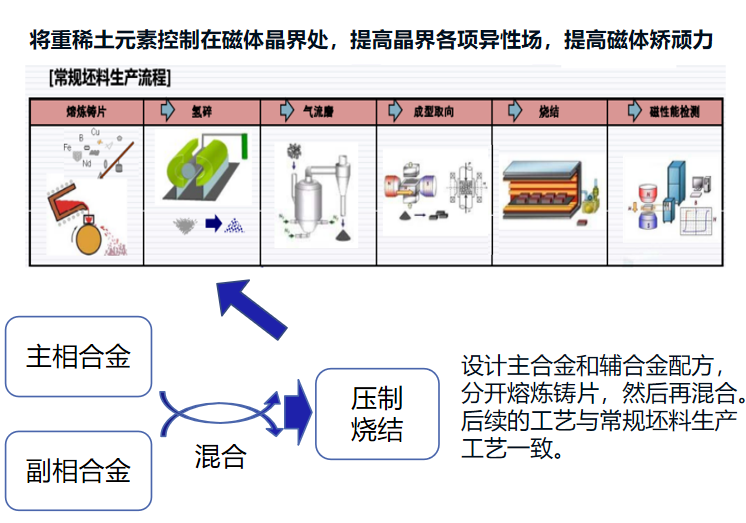
Dual-alloy manufacturing process
The dual-alloy process is an advanced method for manufacturing high-performance NdFeB magnets. It involves separately melting the main-phase and grain-boundary alloys, blending the resulting powders in precise ratios, orienting them, and sintering. The main phase provides high remanence, while the grain boundary phase delivers high coercivity; together, they optimize overall magnetic performance.
This process precisely controls the composition and distribution of grain boundary phases, enabling more efficient distribution of heavy rare-earth elements in the grain boundary regions. This significantly enhances magnetic coercivity while reducing heavy rare-earth usage. Compared to conventional single-alloy processes, magnets produced via the dual-alloy process exhibit superior overall magnetic performance and improved thermal stability.
The key advantages of the dual-alloy fabrication process are:
- Independently optimize the composition of the main phase and grain boundary phase to achieve synergistic improvements in remanence and coercivity.
- Higher utilization of heavy rare earth elements effectively reduces raw material costs.
- Superior high-temperature stability for premium applications such as new energy vehicles and wind power.
Grain boundary diffusion technology
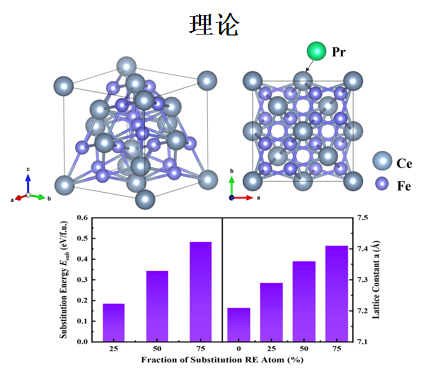
A heavy rare-earth layer is formed on the magnet surface and, after vacuum heat treatment, diffuses along grain boundaries into the bulk. Heavy rare-earth atoms replace Nd atoms surrounding the main phase grains, creating a high-anisotropy "core-shell" structure. This unique microstructure significantly enhances coercivity with negligible loss of remanence.
Generally, for sintered NdFeB magnets with thickness less than 8mm, Dy diffusion increases HcJ by 4kOe–7kOe, while Tb diffusion increases HcJ by 8kOe–11kOe; both methods reduce Br by no more than 0.2kGs.
Compared to conventional non-diffused magnets, the primary advantages of grain boundary diffusion processing are:
- For magnets of the same grade, grain boundary diffusion significantly reduces Dy and Tb usage, lowering costs.
- Grain boundary diffusion enables the fabrication of magnets with superior comprehensive magnetic properties—such as 50EH and 52UH—that are unattainable through conventional manufacturing processes.
Production Process
Complete production process from raw materials to finished product, with strict quality control at every stage.
Ingredients
Weigh rare earth metal raw materials precisely according to the formula.
Smelt
Vacuum Induction Melting for Alloy Ingot Preparation
Jet Mill
Production of Micron-Sized Alloy Powders via Jet Milling
Forming
Magnetic field-assisted alignment and forming
Sintering
Vacuum sintering densification
Process
Cut and grind to target dimensions
Surface finish
Electroplating/Coating Corrosion Protection
Detect
Full inspection of magnetic properties, dimensions, and appearance
Key Production Equipment
Equipped with advanced production and processing equipment to ensure product precision and capacity.
Vacuum Rapid Solidification Melting Furnace
Vacuum induction melting with precisely formulated rare earth raw materials ensures uniform and stable alloy composition, laying the foundation for high-performance permanent magnets.
Jet mill powder
Produce fine alloy powders via hydrogen decrepitation and jet milling, with strict particle size control to enhance magnetic alignment and performance.
Vacuum Sintering Furnace
High-precision temperature-controlled vacuum sintering ensures green magnet density and achieves consistent magnetic performance and microstructure.
Multi-wire cutting machine
High-precision wire EDM machine for machining complex shapes and precise dimensions with micrometer-level tolerances.
Neodymium Iron Boron Magnetic Performance Tester
High-precision magnetic property testing equipment that accurately measures key parameters such as remanence, coercivity, and maximum energy product to ensure product performance meets specifications.
Laser Particle Size Analyzer
High-precision particle size analyzer for accurate powder particle distribution analysis, ensuring consistency in magnetic powder raw materials and product stability.
Quality Control System
Three inspection checkpoints with full-process quality traceability to ensure stable and reliable product performance.
Incoming Inspection
Perform rigorous chemical analysis of rare earth metal raw materials to ensure quality compliance with standards.
Process Control
Establish quality control points at critical process steps to monitor process parameters in real time, ensuring stable and controllable production.
Finished Product Inspection
Perform full inspection of finished products, including magnetic properties, dimensional accuracy, surface appearance, and coating adhesion.
Need customization?
Our technical team delivers end-to-end custom solutions—from material selection to processing—tailored to your specific needs.
Custom Consulting